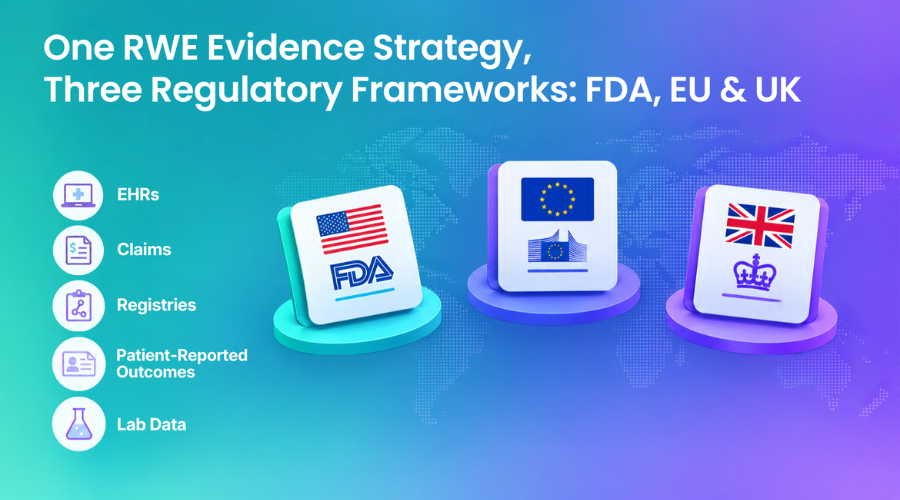
Planning to launch a medical device in more than one market? You have probably heard that real world evidence can speed things up. It can, but the FDA, the European Union, and the UK do not treat it the same way. Here is a side-by-side look at how expectations differ and how to build an RWE regulatory strategy that holds up everywhere.
What Do Regulators Mean by Real World Evidence?
Real world data (RWD) is health information collected during routine care, such as electronic health records, insurance claims, patient registries and data gathered from other sources such as digital health technologies (DHTs) that can inform on health status. Real world evidence (RWE) is the clinical evidence produced when that data is analyzed. All three regions broadly agree on these definitions. The differences lie in how evidence is judged.
FDA Real World Evidence: Relevance and Reliability First
For devices, the FDA finalized its updated guidance, Use of Real-World Evidence to Support Regulatory Decision-Making for Medical Devices, on 18 December 2025. It supersedes the 2017 version and centers on two questions: is the data relevant to the regulatory question, and is it reliable enough to trust?
Key points for FDA real world evidence submissions:
- RWE can support premarket submissions such as 510(k), De Novo, and PMA, as well as post-market decisions.
- Sponsors should document relevance and reliability assessments and share study protocols.
- FDA no longer always requires identifiable patient-level data from sources like registries.
- RWE is weighed within the totality of evidence, not as an automatic substitute for clinical trials.
Early engagement through the Q-Submission program is strongly recommended.
European Union: Life-cycle Data Under MDR
For medical devices, the EU MDR (Regulation (EU) 2017/745) has no standalone RWE guideline. Instead, real world data feeds into EU MDR clinical evaluation through post-market clinical follow-up (PMCF) and post-market surveillance. Notified bodies review this data during conformity assessment.
United Kingdom: A Growing Guideline Series
The MHRA has produced a guideline series on using MHRA real world data in clinical studies. It covers how to judge whether a data source is good enough for its intended use and how to run randomized trials that rely on RWD. In 2025, the agency also consulted on external control arms built from RWD. These documents focus mainly on medicines and apply to studies conducted anywhere.
For devices, new GB post-market surveillance regulations took effect on 16 June 2025. Manufacturers must now proactively collect and assess real-world safety and performance data.
Quick Comparison: FDA vs EU vs UK
Aspect | FDA (US) | EU | UK |
Device RWE approach | Dedicated final guidance (2025) | Built into MDR clinical evaluation and PMCF | Built into GB PMS regulations (2025) |
Core test | Relevance and reliability | Methodology and data quality | Data quality fit for intended use |
Main reviewer | FDA review centers | Notified bodies and EMA | MHRA |
Building a Multi-Region RWE Strategy
- Define the regulatory question first, then choose data sources that answer it.
- Assess data quality early against each region’s criteria.
- Finalize protocols and analysis plans before looking at outcomes.
- Design PMCF and surveillance activities, so one data stream can serve several markets.
- Talk to regulators early, whether through FDA Q-Submissions, European Competent Authority (CA) scientific advice, or the MHRA.
How NexorTest Can Help
NexorTest supports manufacturers with USFDA, EU MDR, and UKCA regulatory consulting, clinical studies, market access and authorized representative services in over 50 countries. Our team helps you plan evidence that satisfies each regulator from day one. Contact us and share your requirements.