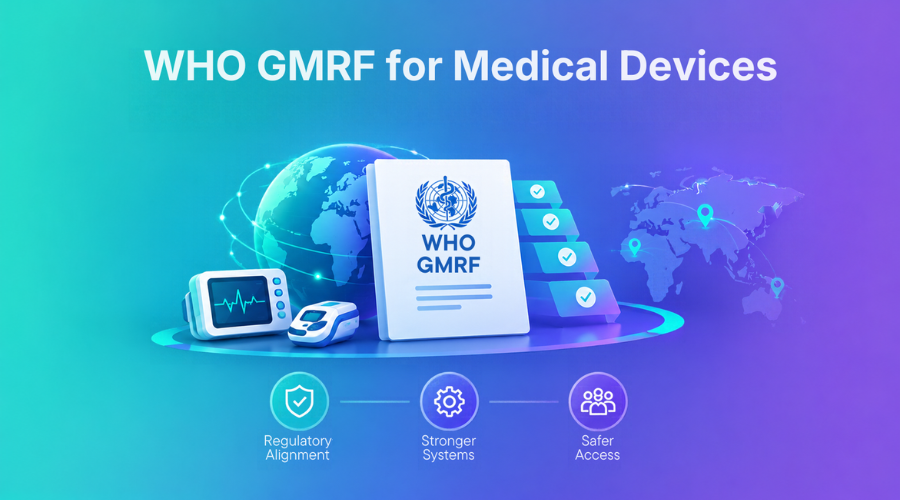
Many developing countries still regulate medical devices with limited laws, small teams, or rules borrowed from medicines. To help such countries, the World Health Organization created the Global Model Regulatory Framework, known as the WHO GMRF for medical devices. For emerging market regulators, it is a practical baseline. For manufacturers, it shows where medical device regulation in many growing markets is heading.
What Is the WHO GMRF?
WHO first published the framework in 2017. A revised version was adopted by the WHO Expert Committee on Biological Standardization in October 2022 and published as Annex 3 of WHO Technical Report Series No. 1045 in 2023, replacing the 2017 text.
It is written for lawmakers and government bodies building national systems, and its main elements come from Global Harmonization Task Force (GHTF) and International Medical Device Regulators Forum (IMDRF) guidance. The revision adds newer topics such as software as a medical device, combination of products, emergency use authorization, and donated devices.
Why It Matters for Emerging Market Regulators
WHO recognizes that many countries lack the funds and expertise to jump straight to a full system. So, the WHO GMRF for medical devices does not ask for everything at once. It recommends starting with a gap analysis of existing controls. For example, a country with little local manufacturing may focus on import controls first. WHO also notes that a modest law that is properly enforced is better than an ambitious one that cannot be implemented.
The Core Building Blocks
- Risk based classification: Devices fall into four classes, A to D, and regulatory scrutiny increases with risk. IVDs are classified by their risk to the individual and to public health.
- Essential principles: Manufacturers must show that a device is safe and performs as intended throughout its life cycle, ideally by applying recognized international standards.
- Quality management system: The framework recommends QMS requirements aligned with ISO 13485:2016 and risk management aligned with ISO 14971:2019.
A Stepwise Path from Basic to Expanded Controls
Basic level controls include publishing the law, registering establishments, listing devices, controlling imports, and adverse event reporting. Expanded level controls add inspections of registered establishments and oversight of clinical investigations. WHO advises that the law should anticipate the expanded level from the start and include transition periods, so device supply is not disrupted.
Regulatory Reliance: Doing More with Less
Regulatory reliance lets a national authority give significant weight to assessments by a trusted reference authority or WHO, while still making its own decision. Some tasks stay national, including import controls, adverse event handling, market surveillance, and withdrawals. Reliance also depends on sameness: the local product must essentially match the one the reference authority approved.
Measuring Progress with the WHO Benchmarking Tool
The WHO benchmarking tool for medical devices, called GBT+MD, helps authorities assess their system against defined indicators. Its latest release, Revision VI+MD version 2, was published in December 2024 and covers six regulatory functions.
What this Means for Manufacturers
As more emerging market regulators align with the framework, expect requests for ISO 13485 certification, a justified risk class, an essential principles checklist, and a local authorized representative. Devices approved by a reference authority may move faster where reliance pathways exist, and more consistent medical device regulation makes one technical file easier to reuse.
How NexorTest Can Help
NexorTest supports medical device companies from design to global market access. We offer ISO 13485 and MDSAP consulting, EMC, electrical safety, biocompatibility, and cybersecurity testing, SaMD regulatory consulting, and authorized representative support in more than 50 countries. Contact us and share your project details and we will map your device to each target market.
Key Takeaway
The WHO GMRF for medical devices gives regulators a clear, stepwise route to effective oversight. For manufacturers, understanding it today makes tomorrow’s registrations faster and more predictable.