
Nexortest Technologies | Your Gateway to Global Market Entry
Healthcare is responsible for around 4.4% of global greenhouse gas emissions, and a large share of that footprint comes from the production, use and disposal of medical devices. Yet the two regulations that govern the sector in Europe, the Medical Device Regulation (MDR 2017/745) and the In Vitro Diagnostic Regulation (IVDR 2017/746), focus almost entirely on safety and performance. Neither one mentions environmental sustainability as an explicit requirement. Environmental, Social, and Governance (ESG) expectations are layering onto existing regulatory frameworks, and they are changing how devices must be designed, manufactured, and documented.
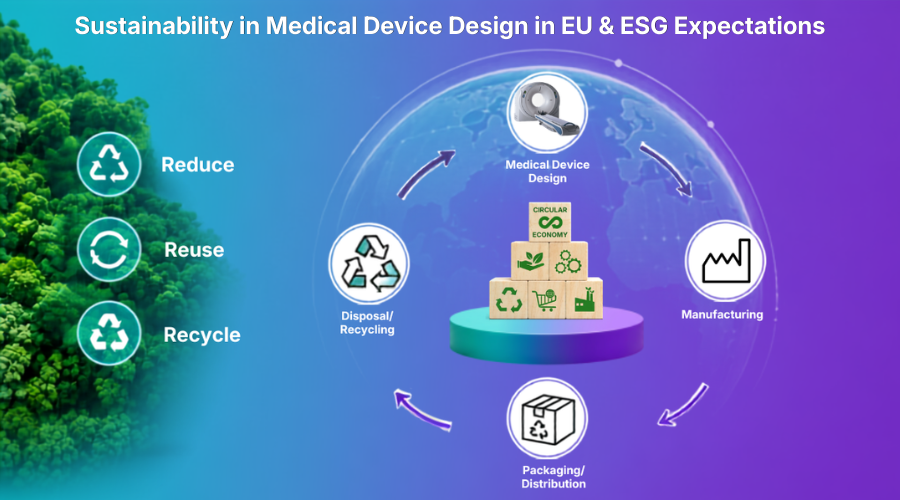
A 2026 policy mapping study in the European Journal of Public Health identified eight binding EU regulations that already apply, or can be transferred, to medical devices, including the ESPR, the Packaging and Packaging Waste Regulation (PPWR), the WEEE Directive, and the Waste Framework Directive. Together they embed circular economy principles across every lifecycle phase, from material selection and packaging to extended producer responsibility and recycling targets. If you design, manufacture, or market medical devices in the EU, sustainable medical device design is no longer optional. Here is what is changing and what to do about it.
Several EU laws now shape how devices should be designed, packaged and retired:
These frameworks touch every phase of the device lifecycle. In research and development, material selection now goes beyond biocompatibility to include recyclability and reduced use of hazardous substances. In production, technical documentation may need to prove sustainability compliance, and traceability tools such as QR codes and the Digital Product Passport are joining EUDAMED and UDI. Post-market, expectations are shifting toward repairability, refurbishment, and take-back schemes. At the end of life, recovery and recycling targets apply where the MDR is silent.
Investors, hospital procurement teams, and Green Public Procurement criteria reinforce the same direction. Sustainability performance is increasingly a market access question, not just a reporting exercise.
MedTech Europe, in its December 2024 position on the EU Circular Economy Act, calls for regulatory coherence between Green Deal legislation and the MDR and IVDR, aligned definitions for reuse, refurbishment and reprocessing, harmonized circularity metrics, and financing that rewards circular business models. Its framing of the five R’s – Reduce, Refuse, Reuse, Renew and Recycle; is a useful design lens, always conditioned on patient safety coming first.
Environmental sustainability is still absent from the text of the MDR and IVDR, but it is no longer absent from compliance reality. The EU Green Deal, the Circular Economy Action Plan, and the regulations built on them are converging on medical devices. Companies that treat ESG in medtech as a design input today will face fewer retrofit costs, smoother conformity assessments and stronger procurement positioning tomorrow and a better future. The EU Circular Economy Action Plan, a core building block of the European Green Deal, promotes designing products for longer life cycles, easier maintenance, and better recyclability. A new Circular Economy Act is under development, with adoption planned by Q3 2026, and MedTech Europe has called for ensuring regulatory coherence between this Act, the Green Deal, and the sector-specific MDR/IVDR framework.
Navigating this intersection of ESG and regulatory compliance requires a partner who understands both worlds. NexorTest provides end-to-end support across medical device design, testing, and regulatory certification, including EU MDR compliance, EU IVDR compliance, environmental testing, and ISO 13485 consulting. Whether you are preparing for CE marking or aligning your device documentation with emerging sustainability requirements, NexorTest helps bridge the gap between innovation and global market access.
Note: This blog article is based on published EU regulations, a peer-reviewed 2026 policy mapping study, MedTech Europe position papers, and other guidance documents.
Regulation (EU) 2024/1781
Ecodesign for Sustainable Products Regulation
Green Forum: Implementing the Ecodesign for Sustainable Products Regulation
European Journal of Public Health, 2026
MedTech Europe, EU Sustainable Prosperity and Competitiveness
Corporate Sustainability Reporting
EU Circular Economy Action Plan
Waste from Electrical and Electronic Equipment (WEEE)
EUR-Lex, EU Battery Regulation (EU) 2023/1542
European Green Deal

Chief Compliance Officer at NexorTest Technologies