Case Study
How Predicate Finder Catches What Manual 510(k) Searches Miss
How Nexorx.ai Predicate Finder helped a medtech team strengthen its 510(k) predicate selection and analysis by reviewing FDA 510(k), UDI, MAUDE, and recall data together. The platform helped identify a risky predicate, evaluate an alternative, and support the substantial equivalence assessment before FDA submission in minutes and not weeks.
Background
A mid-market medtech company was preparing a 510(k) submission for a new image-based diagnostic support device. Their regulatory team had already done what most teams do: searched FDA’s 510(k) database by product code, pulled a shortlist of similar cleared devices, and picked the closest match by intended use and technology.
On paper, their top candidate looked right. Same product code, same intended use language, cleared within the last few years.
The Problem
What the days of search didn’t surface was sitting in two other FDA systems the team hadn’t cross-checked yet: MAUDE adverse event reports and the recall database.
Checking predicates against 510(k) records alone tells you if a device is a technological match. It doesn’t tell you what’s happened to that device since clearance. A predicate with an open recall, or a pattern of adverse events tied to the same failure mode as the device being submitted, can turn a review of conversation into an unfavorable one. At worst, it invites the exact kind of FDA scrutiny a submission is trying to avoid.
The team’s existing process meant checking 510(k), UDI, MAUDE, and recall data as four separate manual lookups, on four different FDA interfaces, for every candidate on the shortlist. That’s slow, and it’s easy for a match found in one database to never get cross-checked against the others.
How Nexorx.ai Predicate Finder Helped
1. Search for intended use
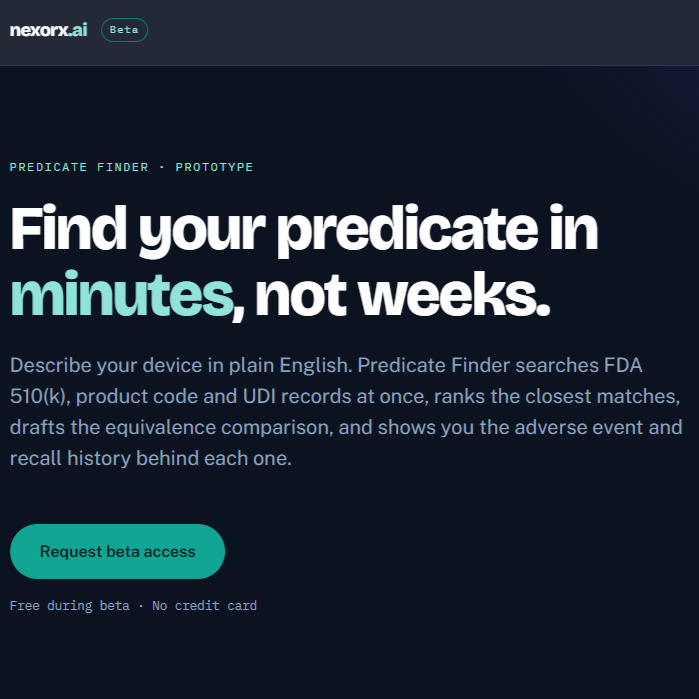
The team pasted their intended use statement directly into Predicate Finder. It searched 510(k), UDI, and product code records in parallel and returned ranked matches, each linked back to its source FDA record.
2. Draft the equivalence analysis
They pinned their top three candidates. Predicate Finder generated a rationale for each, along with key similarities, critical differences, and a parameter-by-parameter comparison table, the same structure a 510(k) submission needs for its substantial equivalence section.
3. Check the adverse events
For every shortlisted device, Predicate Finder pulls MAUDE reports matched on brand and product code, event type and date included. This is where the leading candidate’s problem showed up: a cluster of adverse events reporting the same failure mode the new device was designed to avoid.
4. Screen the recalls
A recall check on the same candidate confirmed it: an open recall, with a stated reason that lined up with the adverse event pattern. Recall numbers, status, classification, and initiating firm were all there, so the team could see exactly what they’d be attaching to their submission if they used that device.
With the full shortlist exported to Excel, the team could see all four data sources side by side for every candidate, not just the one they’d been about to submit.
Outcome
The team dropped the flagged candidate and moved to their second-ranked match, which had a clean adverse event and recall history. That is what FDA reviewers look for in a predicate comparison. Predicate Finder had already drafted the equivalence analysis for that second candidate, so the switch cost them nothing in the redone work.
Before, this meant checking every candidate by hand across four separate FDA databases. Now it is one search, and the safety history shows before a risky predicate ends up in the submission.
Why This Matters
Product code and intended use tell you whether a device is similar. They do not tell you whether it is safe to build a submission around it. By the time an FDA reviewer flags that, changing predicates is expensive. Nexorx.ai Predicate Finder answers both questions in minutes, not days.
Working on a 510(k) submission? Request beta access to Predicate Finder or contact us and see what your predicate is carrying before it’s in front of the FDA.
Predicate Finder is a working prototype built on publicly available FDA data. It does not constitute regulatory, legal or clinical advice, and its outputs, including AI-generated equivalence assessments, must be independently verified by a qualified regulatory professional before use in any submission. Substantial equivalence is determined solely by the U.S. Food and Drug Administration.
Meet Our Regulatory Expert

Dr. Pabbisetty PBS Kumar
Chief Compliance Officer at NexorTest Technologies
Newsletter
Sign up our newsletter to get update information, promotion or insight.