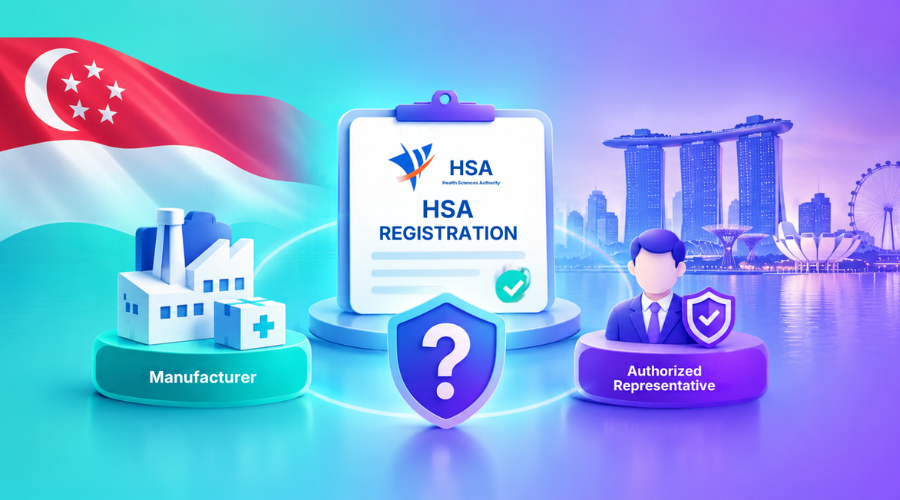
If you manufacture medical devices outside Singapore, who will represent you before the Health Sciences Authority (HSA)? Many manufacturers search for an “Authorized Representative in Singapore,” but HSA’s official legal term for this role is the Registrant.
Do You Need an Authorized Representative in Singapore?
In practice, yes. An overseas product owner needs a Singapore-registered entity to submit and hold the registration of a Class B, C or D device. Applications go through HSA’s SHARE system. SHARE requires CorpPass access linked to a Singapore Unique Entity Number (UEN), so an overseas manufacturer cannot normally apply directly.
You have three options:
- Set up your own Singapore subsidiary.
- Appoint your distributor or importer as the Registrant.
- Appoint an independent Singapore-based Registrant.
An independent Registrant doesn’t have to be the importer. However, any company importing or wholesaling medical devices in Singapore must hold the applicable HSA dealer’s licence and be authorized by the Registrant to import the device.
What does an HSA Registrant do?
Your Registrant is more than a mailing address. It:
- Prepares and submits the application through SHARE, supported by the ASEAN CSDT or other accepted documentation.
- Responds to HSA queries. The review stays on “stop-clock” until HSA receives a complete response.
- Assesses device changes under GN-21 and submits Change Notifications where required.
- Pays the annual retention fee. Payment more than 30 days late requires justification. After 60 days, HSA cancels the listing and the device can no longer be imported or supplied.
- Is named alongside the product owner on the Singapore Medical Device Register (SMDR).
After a device is on the market, qualifying adverse events must be reported within set deadlines:
- 48 hours for a serious threat to public health.
- 10 calendar days for death or serious deterioration in health.
- 30 calendar days for events that could cause death or serious injury if they recur.
For a Field Safety Corrective Action (FSCA), HSA must be notified before it begins.
The Letter of Authorization
The Product Owner appoints the Registrant through a Letter of Authorization using the GN-15 Annex 1 template. It is printed on company letterhead and signed by a senior official. The letter identifies the covered devices, authorizes submissions on the Product Owner’s behalf and commits the Product Owner to providing post-market support. It stays in effect until the Product Owner notifies HSA in writing that it has been revoked.
What Changed in 2026?
- GN-15 Revision 14 (effective 14 September 2026) added Annex 4, the Device Labelling, AE and FSCA Declaration. Section 1 requires abridged, expedited and immediate applications to disclose differences between the Singapore labelling and the reference agency’s approved labelling. Section 2 requires all applications to disclose reportable AE and FSCA history.
- GN-15 Revision 13 (effective 10 March 2026) introduced reliance on Malaysia’s Medical Device Authority (MDA). Class B, C and D devices may qualify for the abridged route if MDA registered them after a full conformity assessment by an MDA-recognized body. The labelled use must be identical to the intended Singapore use.
- GN-21 Revision 7 (effective 1 August 2026) clarified administrative and notification changes. It also allows no more than two active Change Notifications per device listing.
- GN-02 Revision 8 (effective 1 April 2026) requires the audit report to be submitted with the ISO 13485, MDSAP or GDPMDS certificate for new dealer-licence applications and specified amendments.
Registration Routes at a Glance
Class A devices are exempt from registration, but a Product Notification must be submitted through SHARE before supply.
Class B, C and D devices must be registered. Devices without an approval from an HSA-recognized reference agency generally go through full evaluation. Others may qualify for the abridged, expedited or immediate route, depending on class, approvals and safety history.
Recognized approvals include specified approvals from:
- The US FDA
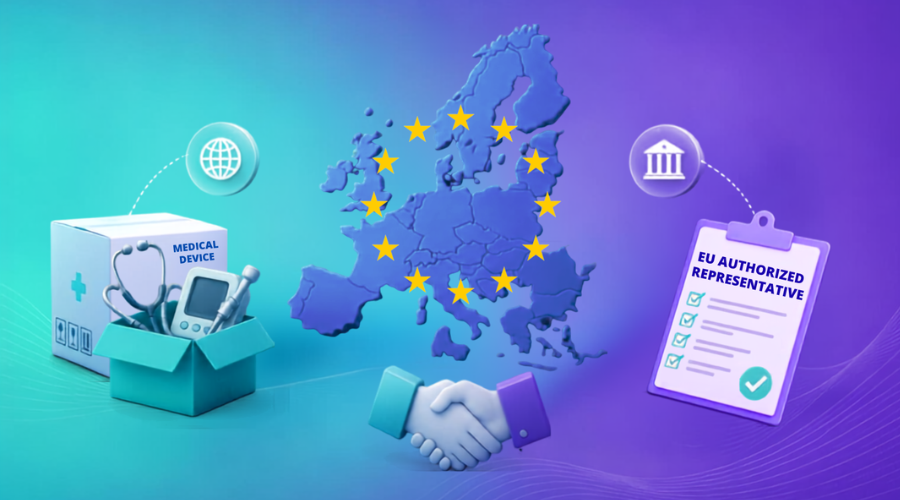
- EU Notified Bodies
- Health Canada
- Australia’s TGA
- Japan’s MHLW
- Malaysia’s MDA, under the reliance conditions above
The approval must cover the same device and labelled use, and all conditions of the chosen route must be met.
How to Choose a Registrant in Singapore
- Independence. If your distributor is the Registrant, switching distributors may require a Change of Registrant under GN-24, which needs both companies’ cooperation. Cover transition obligations in the contract.
- Track record. Search the SMDR to see which devices a company already holds.
- Regulatory depth. Ask who answers HSA’s technical questions, and how fast.
- Clear contract. Define dossier access, confidentiality, fees, retention payments, post-market duties and exit terms.
- Licensing status. If the Registrant will also imports or wholesale your devices, confirm it holds valid dealer’s licences.
How NexorTest Can Help
A strong dossier makes registration easier for everyone. NexorTest supports manufacturers with:
Where an approval from these pathways meets HSA’s conditions, it may support a faster Singapore evaluation route.
Planning your Singapore entry? Contact us for a registration roadmap.