The market for general wellness technology is expanding rapidly, with innovators launching new apps, wearables, and other products designed to promote healthier lifestyles. Navigating the intersection of consumer health and medical regulation requires a precise understanding of where a product sits on the regulatory spectrum. On January 6, 2026, the US Food and Drug Administration (FDA) issued guidance documents relating to general wellness products (General Wellness Guidance). The compliance landscape for low-risk products that promote a healthy lifestyle is defined by a clear policy designed to foster innovation in digital health and wearables without unnecessary oversight. In this 2026 General Wellness Guidance document policy now expressly includes “wearables,” which monitor physiological characteristics.
The primary focus is on providing a predictable pathway for products that encourage wellness. This update is particularly relevant for the digital health sector, as it clarifies the application of statutory amendments that remove certain software functions from the definition of a medical device when they are intended solely for maintaining a healthy lifestyle.
What Qualifies as a General Wellness Product
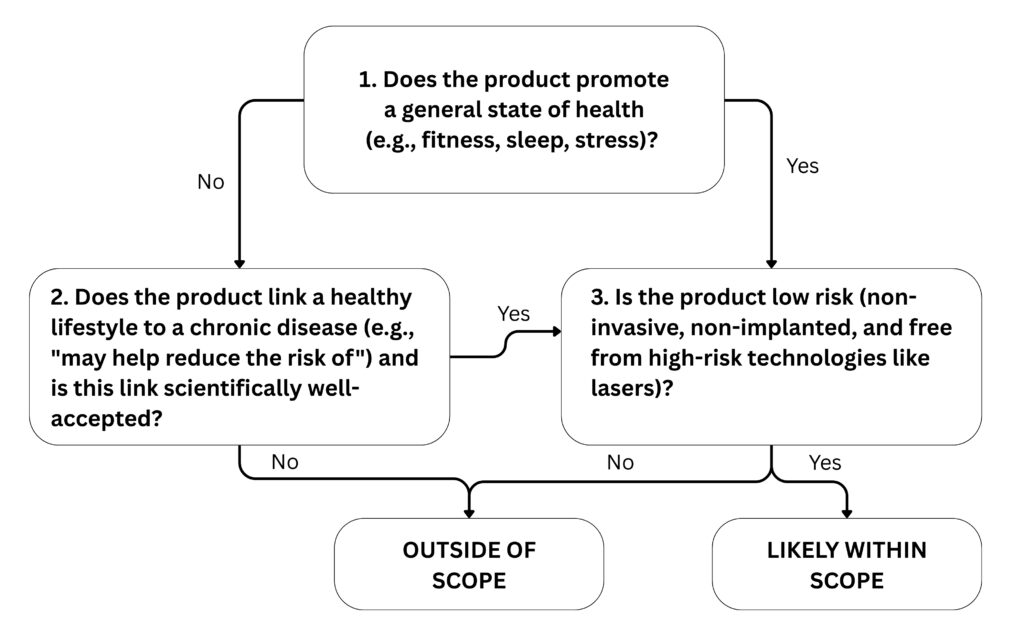
A product falls under this wellness policy if it meets two fundamental criteria: it must be intended strictly for general wellness use, and it must present a low risk to user safety. The intended use is further divided into two specific categories:
General State of Health: These claims focus on sustaining or improving overall health functions without referencing any specific disease or condition. This includes weight management, physical fitness, relaxation, stress management, mental acuity, self-esteem, sleep management, and sexual function.
Healthy Lifestyle Roles in Disease Management: These claims link a healthy lifestyle to reducing the risk or impact of chronic diseases. This is only permissible when the association, such as exercise helping to reduce the risk of high blood pressure, is well-understood and generally accepted within peer-reviewed scientific literature or by professional healthcare organizations.
What Is Explicitly Out of Scope
The boundary between a wellness product and a regulated medical device is defined by the clinical nature of the claims or technology. A product is not considered a general wellness tool if it is intended to measure or report physiologic values for medical purposes, such as screening, diagnosis, or disease management.
Directly excluded features and claims include:
- Specific medical hardware such as blood pressure monitors, glucose meters, and ECG recording devices.
- Functions that provide outputs for making treatment decisions, such as calculating medication dosages.
- Claims of clinical accuracy, “medical grade” status, or clinical equivalence to a regulated device.
- Active alerts, alarms, or prompts that recommend specific clinical actions or medical management.
- Functions that identify or name a specific disease or characterize a user’s physiological output as “pathological” or “abnormal”.
Low-Risk Threshold Explained
The enforcement discretion policy applies only to products that do not cross specific safety thresholds. A product is disqualified from the “low risk” category if it is invasive, meaning it penetrates or pierces the skin or mucous membranes. It is also excluded if it is an implanted device.
Furthermore, technology that poses a safety risk requiring specific regulatory controls is excluded. Examples include:
Products using lasers for skin rejuvenation or sunlamps for tanning involve risks like burns or skin cancer.
Neurostimulation products claiming to improve memory are excluded due to risks associated with electrical stimulation.
Products using venipuncture or microneedles to test parameters like lactic acid or glucose are not low risk.
Software and Wearables: Where the Line Is Drawn
Digital health developers often utilise non-invasive sensing, such as optical sensors, to estimate physiological parameters. These are treated as wellness products if they are non-invasive, not implanted, and do not have any medical intent.
Parameters such as heart rate, oxygen saturation, or blood pressure can be displayed as trends, baselines, or summaries within wellness domains like sleep or recovery. However, if these values mimic those used clinically, they must be validated through testing or peer-reviewed literature. While a product may notify a user to seek a professional evaluation if an output falls outside a wellness range, it must not provide a diagnosis or recommend a specific clinical action.
To determine if a product falls within the scope of this policy, follow this logical pathway:
Practical Examples
The following examples illustrate how these rules apply in real-world scenarios:
Software and Mobile Apps
- Included: An app that plays music for relaxation, a calorie tracker for weight management, or a tool that reminds users to avoid sun exposure based on the UV index.
- Excluded: A computer game claiming to treat autism or an app claiming to treat an anxiety disorder.
Wearables and Consumer Products
- Included: A wrist-worn device monitoring pulse rate during exercise or a mechanical tool for skin exfoliation that does not penetrate the skin.
- Excluded: A wearable using microneedles for glucose monitoring (invasive) or a laser product for skin rejuvenation (safety risk).
Key Takeaways
- Registration and Listing: For products meeting the low-risk wellness criteria, there is an intention not to enforce requirements for registration, listing, or premarket notification.
- Quality Standards: Note that as of 2 February 2026, the relevant quality standard is the Quality Management System Regulation (QMSR).
- Labeling Integrity: Marketing and promotional materials must be consistent with wellness use and must not exceed the stated intended use.
- Validation: Physiological outputs that mimic clinical values require validation even if they are marketed solely for wellness.
Final Summary
This regulatory framework provides a clear boundary for developing products that empower users to manage their own health. By strictly adhering to non-invasive technologies and focusing claims on general health or well-accepted lifestyle roles, product teams can position their innovations within the wellness category, avoiding the complexities of the medical device regulatory pathway.

Meet Our Regulatory Expert
Dr.Pabbisetty PBS Kumar
CHIEF COMPLIANCE OFFICER
NEXORTEST TECHNOLOGIES